
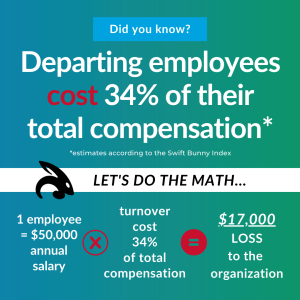
 Employee turnover is a significant concern for businesses of all sizes and industries, but we know it is particularly distressing for the rental housing industry. While the immediate impact of losing an employee is often clear, there are a multitude of hidden costs associated with turnover that are not typically accounted for during budget season. Managers at every level, this one is for you! In order to understand the true financial and operational implications of high turnover rates, take note of the following various costs that organizations face when employees walk out the door. The costs of employee turnover fall into four categories: separation costs; productivity costs; recruitment costs; resident turnover cost due to the impact of employee turnover on resident satisfaction and retention. Due to the Employee Profit Chain and costs associated with employee turnover, Swift Bunny estimates departing employees cost 34% of their total compensation. To put that in perspective, if a community loses one employee with a $50,000 annual salary, that community will take a $17,000 hit to their bottom line! To provide additional clarity, here are just some of the areas that contribute to employee turnover costs:
1. Accrued Paid Time Off (PTO)
According to research by Zippia, departing employees leave with an average of 6.5 unused PTO days. This means that businesses in most states must compensate departing employees for the accrued but unused time, resulting in additional expenses for the organization.
2. Manager and HR Staff Time
Losing an employee requires extensive time and effort from both managers and HR staff that is rarely accounted for. Managers may spend significant hours trying to retain the employee, discussing potential other roles or locations, conducting exit interviews, and adjusting for a loss of productivity and customer service. Additionally, HR staff must handle exit interviews, and process paperwork related to payroll, benefits and other offboarding necessities. On the hiring side, the HR team's time spent on screening, conducting assessments, interviews, making job offers, and facilitating new hire paperwork also contributes to the overall cost.
3. Overtime and Temporary Employee Costs
When an employee leaves, their workload must be distributed among the remaining staff or covered by temporary employees. This often leads to overtime costs and added stress for existing employees who may have to work extra hours until the vacant position is filled. Paying overtime at 1.5 times the hourly rate, as reported by TheBalanceCareers.com, can quickly escalate expenses, and temporary staffing costs often exceed the company’s standard compensation for the needed role.
4. Recruiting and Hiring Costs
Recruiting service costs can be substantial, often ranging from 20% to 30% of the first-year salary for a new hire. In tight job markets, the need for recruiting services is even greater, leading to more expenses for the company. Additionally, external hires may demand up to 18% higher salaries, as reported by the University of Pennsylvania Wharton School of Business, further increasing recruitment costs. Remember that Leasing Agent you were paying $50,000? Their replacement could now cost you $59,000! Advertising for open positions is another financial burden, especially if multiple job sites are used to attract candidates.
5. Training and Onboarding
Once a new employee is hired, the onboarding and training process begins. The time needed for a new hire to become effective in their role can be substantial. MIT/Sloan Review estimates that it takes an average of 90 days for a new employee to become effective, meaning even with that new employee on board, the rest of the team is still picking up the slack for a few months. Onboarding may include hours spent interacting with a Learning Management System (LMS), attending in-person training, or shadowing peers to gain job-specific insights. In addition to the new employee’s time spent on training activities, existing staff may need to invest additional time in onboarding new hires, building relationships, and providing support. These indirect costs of onboarding can have a significant impact on productivity and team dynamics.
6. Ancillary Costs
Ancillary costs, though seemingly minor, can add up. Expenses such as background screening services, uniforms, tools, swag, welcome gifts, and business cards for new hires can be easily overlooked but should not be ignored when considering the total cost of employee turnover.
7. Additional ‘Soft’ Costs
The soft costs of turnover are the ones that typically go unseen and are rarely accounted for until they lead to larger issues. Lost productivity and lost knowledge are two incalculable soft costs. An employee’s value, productivity, and knowledge about your product, brand, processes and more, appreciates over time. The longer they stay with your company, the more these time and experienced-based assets increase. When team members leave, the remaining team members experience not only the shift in the company’s dynamics, but they often pick up (usually unsustainable) workloads. Your turnover is also an indicator of what it’s like to work for your company, and as that number fluctuates, it can be jarring not only to your team, but can also be a deterrent for new recruits.
8. Impact of Employee Turnover on Resident Turnover
Often overlooked is the significant impact on-site employee turnover and staff shortages have on resident retention. As a service-focused industry, a cost to keep in mind is the negative impacts high employee turnover has on your customers. It becomes increasingly harder to nurture positive relationship when your team is constantly changing. For example, leasing and maintenance technician vacancies lead to slower response times, and longer service request turnaround times. On-site staff shortages clearly impact productivity and service delivery, which causes unnecessary resident dissatisfaction and extremely costly turnover. Research validates this strong correlation between staff dependability and responsiveness on the likelihood a resident will renew their lease. 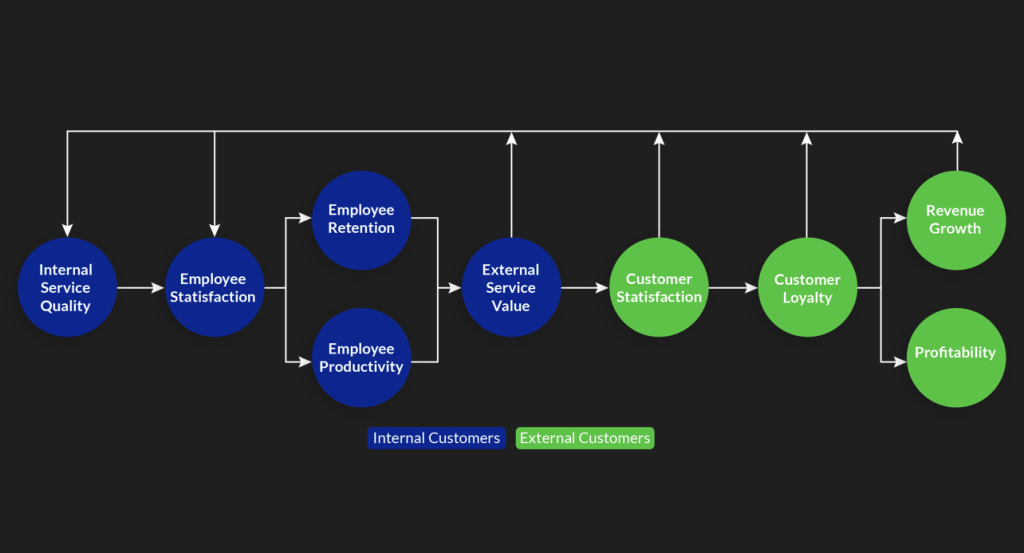 The good news is that a lot of employee turnover is preventable, and the key, it turns out, is boosting employee engagement. Often, the things that cause good employees to go elsewhere can be influenced and improved if leaders are willing to address the most common concerns. But in order to address the concerns, you need to understand what they are, and that is as simple as asking the team how things are going. Fail to do so, and employees may believe their value, well-being, and opinions don’t matter to the company. Checking in, uncovering common frustrations, and addressing them through a continuous feedback loop can be a company’s most powerful weapon to protect against employee turnover and the mounting costs it incurs. Leaders need to take a comprehensive approach to understanding the full spectrum of costs associated with employee turnover. When you turn a blind eye to what employees truly want and need, it’s easy to lose sight of what matters most and how to positively address their priorities and risks. Want to know how much employee turnover is costing you? Schedule a free personalized demo with one of our experts and we can help you learn more about the actuality of turnover costs in your organization!