
A source of guiding light ignited just over 100 years ago. It is one of the most commonly quoted mottos regarding how to approach customer service:
“The customer is always right.”
We love that one, don’t we? And yet, 100 years old is …old. With great respect to Harry Gordon Selfridge of London, England’s Selfridge Department Store, I am retiring this gold nugget of wisdom and ushering in a new focal point. It’s not new in its effectiveness, but it somehow has been overlooked in our managerial shuffle. In the words of Sir Richard Branson:
“Clients do not come first. Employees come first. If you take care of your employees, they will take care of your clients.”
Maybe not as catchy, but definitely attention-getting. Whether an SVP, a staff accountant, a property manager, a leasing agent, a maintenance tech, or a housekeeper, each employee should feel that they have the tools, resources, appreciation, and training to feel productive and valuable. If they feel supported, they are more willing and able to support the residents. But let’s start with a little context. Resident turnover has consistently fluctuated between 46% and 56% since 2011, according to NAA’s Annual Income and Expense Report. As a result, many property management companies have developed finely tuned resident retention programs that may include service guarantees, unique amenities, memorable resident events, and more. Property management companies have been demonstrating the customer is always right … by expecting their employees to constantly act on how right the customer is! Employees are drilled to focus on response times to calls and emails, service with a smile, online reputation management, mental gymnastics to reinvent the pool party, and on and on. The result? Resident turnover remains between 46% and 56%. As an industry, we are living the definition of insanity: doing the same thing over and over and expecting different results. What we have been overlooking is the Service – Profit Chain, which shows the links connecting Employee Satisfaction to Employee Retention to Customer Satisfaction to Customer Loyalty: 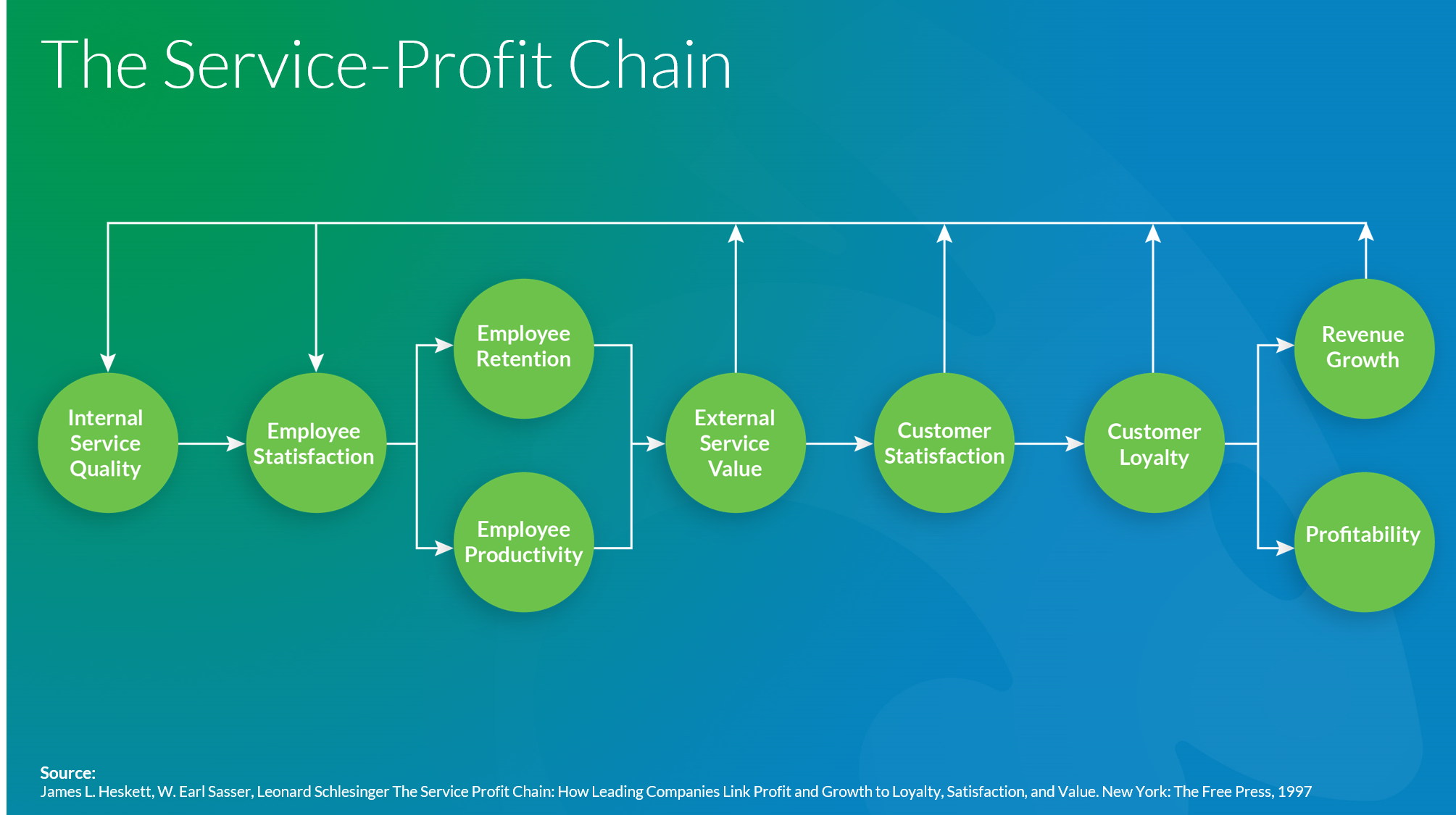 As an industry, we’ve been so focused on ensuring the second half of the chain is intact that we often ignored the health and strength of the first half of the chain. Employee turnover has remained between 30 and 33% since 2011, and since the pandemic those turnover numbers have been reported to exceed 50%. As staff turnover erodes the familiarity and relationships created by the community teams caring for a resident’s home, the opportunity to build and maintain resident connection and loyalty erodes as well. And all that lost training! With high levels of turnover, education teams and HR departments are scrambling to focus training on the basics: Fair Housing, Sexual Harassment, and tech stacks. The tenured employees, despite any company-mandated laser focus on resident retention, are dealing with being short-staffed. Team focus is on operations and shift coverage, with well-meaning intentions of providing service with a smile. Yes, there are success stories out there, but not consistently and not in great volume. The focus on the resident is not paying off. It’s time to shift our focus as an industry and as a culture to those who can change the game: our employees. Company culture flows from how top management treats, speaks to, and speaks of its employees. It’s a learned behavior, so how one manager sees an executive leader or peer respond to someone is how they will personally respond to another peer or employee. That response and attitude is then replicated to co-workers and finally customers. For example:
- How can we expect employees to return resident calls and emails the same day, if they can’t get HR, Accounting, or their Regional to call them back within the same week?
- How can we expect employees to provide service with a smile if their weekly interaction with corporate is a weekly budget browbeating and relentless reminders of reporting deadlines?
- How can we expect employees to respond to online resident reviews with grace, tact, and a problem-solving approach when the property management company ignores the online employee-generated reviews that warn job-seekers away?
- How can we expect employees to invent unique and creative resident events when new hire orientation and annual Fair Housing training are the same, tired, death-by-PowerPoints that have been in place for the last 15 years?
Research has shown a direct relationship between employee turnover and resident turnover. The lower the employee turnover, the lower the resident turnover – and of course the converse is true. The higher the employee turnover, the higher the resident turnover. 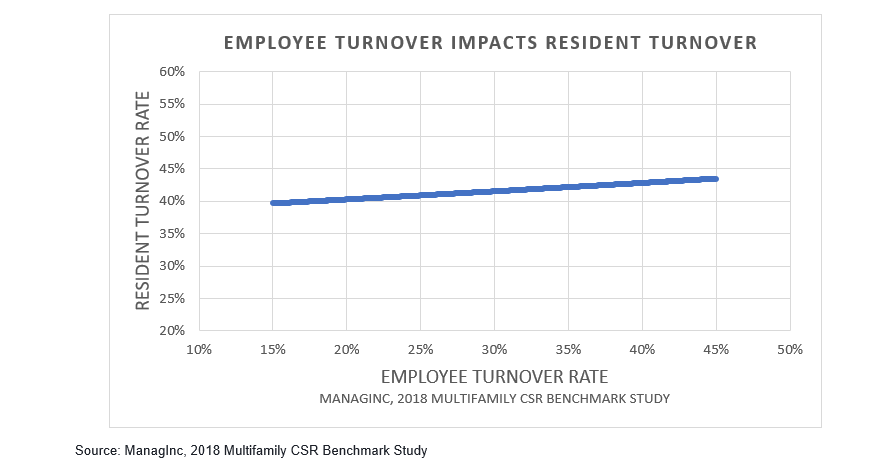 Our collective focus has been slightly misplaced, and it’s time for course correction, especially as employee turnover remains high and increasing concerns of inflation hit the headlines. The current decline in rental rates in the housing market could be just a glimpse of things to come. Delinquencies and vacancies are increasing, concessions are reappearing, and revenue growth is at stake. While there are certain economic factors that we can’t anticipate or control, there are tangible actions that can influence and improve your organization’s position ahead of the competition. Shift your focus to employee engagement, and you will see them reduce your resident turnover. Here are some concrete numbers to help illustrate the benefit. Using the conservative industry estimate that the average turnover cost per move-out is $1,750, and NAA’s report of 51% average resident turnover, a 5,000-unit portfolio will lose $4,462,500 over the course of one year. Based on client case studies, reducing employee turnover by three points results in an average reduction in resident turnover of 4 points, taking the overall average resident turnover down to 47%. That shift in focus reduces resident turnover cost by $350,000! (And please note that we haven’t even talked about the savings on the employee recruitment side!) Resident retention continues to be important. That has not changed. What has changed is our understanding of what is more important, and that is to prioritize employee engagement and retention – in other words, to focus on the service-profit chain. By doing so, companies can have even greater success on their resident retention efforts. The employees win, the residents win, and the company wins! Take these three steps to evaluate and manage your entire service-profit chain, beginning with the ones who have direct contact with your residents: your employees.
- Look at your employee and resident turnover trends for the past 3 years. How do they compare to the relationship graph above?
- Find out what motivates and engages your employees, what they love about the company and what they wish would change. Currently, only 49% of Property Management companies have an Employee Feedback program while nearly 88% have Resident Feedback programs in place. When is the last time you asked what matters to your team? Pro tip: Bring in a 3rd party provider to conduct a confidential survey. Participation will be higher, and the information will be more candid.
- Implement improvements based on what matters most to your employees and promote the things that employees appreciate about your culture.
It’s time to connect the dots between employee satisfaction and resident turnover. Yes, satisfied resident customers matter. But the methods we’ve been using to please them don’t work. The way to earn resident satisfaction and retention starts with a satisfied workforce. 